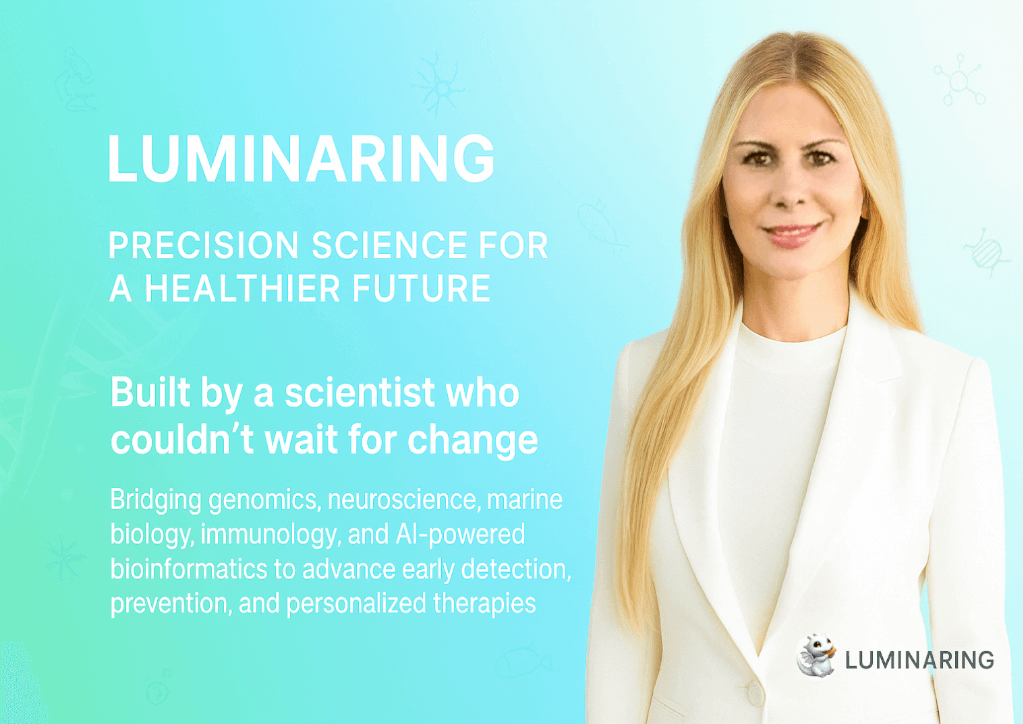
Founder Publications & Achievements
A curated overview of Dr. Maria Carolina Gallego Iradi’s scientific journey: education, landmark discoveries, peer‑reviewed publications, and global contributions.
From consciousness to creation
“During my marine biology thesis, I was told that what I wanted to achieve, in the time I intended, was impossible. No one had done it at that university before. Yet in just a few months, I made it happen.
Years later, few believed dolphins could exhibit Alzheimer-like pathology. It took years of proof, but I showed they could.
What science calls a limitation, consciousness redefines as a portal. Luminaring was born from that shift — not to follow science, but to redesign its rules. When you cross the threshold of comfort, you enter the space where new biology begins.”
Dr. Maria Carolina Gallego Iradi
🔬 Selected Scientific Discoveries
- Cellular recovery after apoptosis (Anastasis): During live-cell culture of human H4 neuroglioma cells, observed spontaneous recovery of cells previously undergoing apoptosis — an early independent observation of cellular resilience that later inspired Luminaring’s regenerative focus.
- Protein droplet condensation in neurodegeneration: Demonstrated that Matrin-3 drives RNA-deficient TDP-43 droplet-like condensation, providing new insight into ALS pathogenesis.
- Cross-species Alzheimer discoveries: Discovered Alzheimer-type pathology and a novel APP isoform in dolphin species, published alongside international collaborators and featured in The Times.
- Thymic transcriptomics: Contributed to the Stanford–Oxford immunology collaboration mapping checkpoints in T-cell maturation and thymic aging.
- Ion-channel trafficking in spinocerebellar ataxia (SCA13): Characterized how KCNC3-R420H mutation disrupts neuronal transport and stability, linking molecular defects to neurodegeneration.
🎓 Academic & Research Milestones
- Bachelor’s in Marine Biology – Cum Laude: Thesis on lead bioaccumulation in oysters; national research on coastal ecosystems.
- Master’s in Waste Management – Cum Laude: Sustainable water and waste treatment systems, environmental impact monitoring.
- PhD in Neurobiology – Cum Laude: Alzheimer-type pathologies in dolphins, novel APP isoform discovery, comparative analysis across species.
🧬 GenBank Contributions
Submitted multiple gene sequences—APP, BACE, PSEN1/2, Aβ—in dolphins and dogs, enriching the global genomic database for neurodegenerative research.
🌐 International Collaboration & Media Coverage
Collaborated with Oxford & St Andrews on Alzheimer’s comparative studies.
📺 Selected News & Media
- National Geographic Italy
- The Times
- Discover
- TheConversation.com
- Neuroscience News
- NetDoctor UK
- UF News
- Chicago Tribune
- Los Angeles Times
- Newsweek
- CBS, WCAX, McKnight Brain Institute, NY Daily News, Gizmodo…
- Diario Sol de Margarita (1998, 2006)
🏥 Research Contributions at Top Institutions
- Stanford University – School of Medicine, Department of Pediatrics (Stem Cell Biology and Regenerative Medicine): Worked within the Stanford Stem Cell Building, leading single-cell and transcriptomic studies on thymic biology and T-cell development as part of the Stanford–Oxford collaboration on immunology and aging.
- University of Florida – McKnight Brain Institute & CTRND (Departments of Neurology and Neuroscience): Completed postdoctoral training and later held a faculty position. Conducted mechanistic studies on Matrin-3 aggregation, TDP-43 pathology, and spinocerebellar ataxia (SCA13). During live-cell culture of human H4 neuroglioma cells, independently observed spontaneous recovery of cells previously undergoing apoptosis — a phenomenon later described as anastasis. These observations inspired Luminaring’s focus on resilience and self-repair in living systems.
- University of Zaragoza – Department of Human Anatomy & Neuroscience: Contributed to genomic Alzheimer’s disease research using human tissue, animal models, and cellular systems.
📄 Selected Peer-Reviewed Publications
- 2019: Phase separation of Matrin-3 and recruitment of TDP-43. Laboratory Investigation.
- 2018: Matrin-3 mutation networks in ALS. Scientific Reports-Nature.
- 2018: Alzheimer’s across species. Alzheimer’s & Dementia.
- 2016: Matrin-3 heterogeneity in murine CNS. Journal of Comparative Neurology.
- 2015: Subcellular localization of Matrin-3 mutations. PLoS ONE.
- 2014: KCNC3-R420H trafficking impaired. Neurobiology of Disease.
- 2010: APP isoform cloning in dogs. Neuroscience.
- 1999: Study of shrimp farming effluent. Saber Magazine.
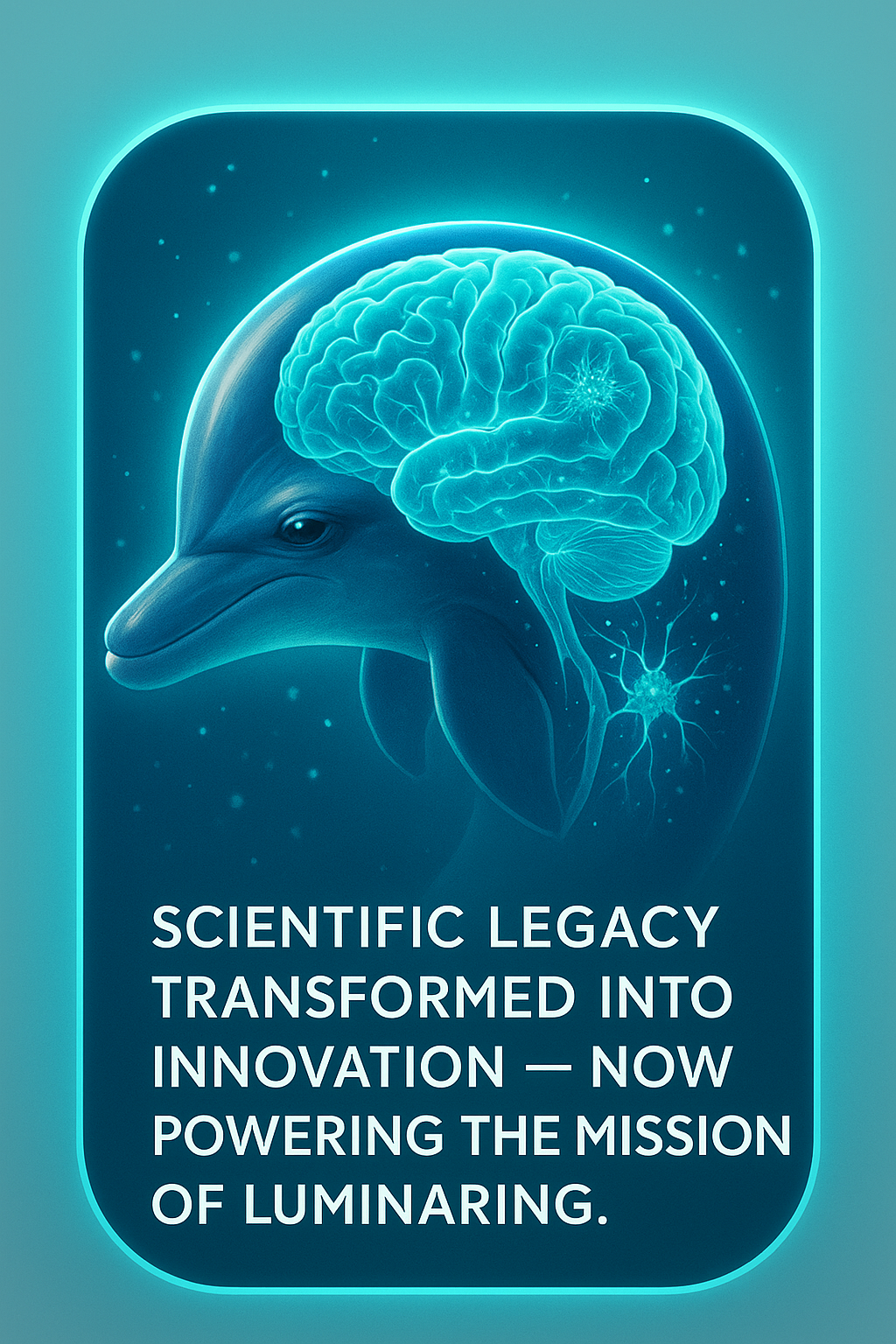
Luminaring is not just a research legacy — it’s a gateway to the future of precision science. Let’s shape it together.